
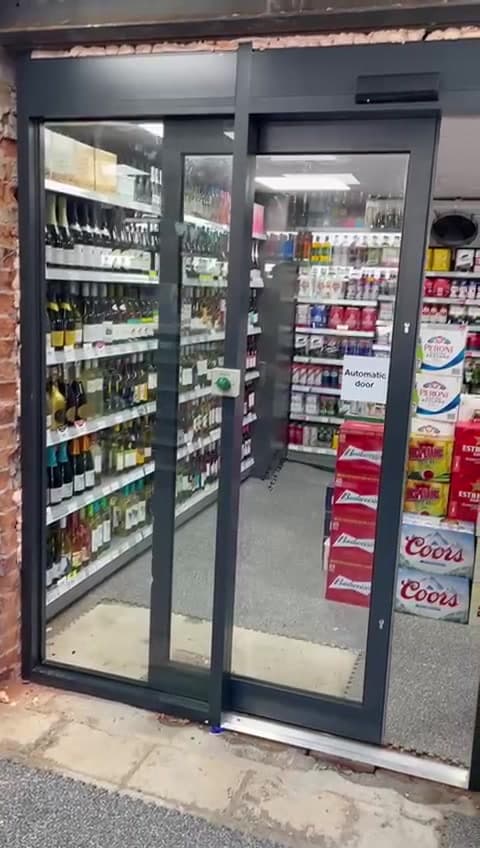
Automatic Doors
Sliding and swing automatic door systems for retail and commercial premises. BS EN 16005 compliant, with full sensor packages and service plans available.
Automatic doors are no longer a luxury reserved for supermarkets and airports. For any commercial premises with significant footfall — a busy high-street retail unit, a medical centre, a hotel lobby, or a multi-occupancy office building — automatic door systems offer a compelling combination of accessibility compliance, operational efficiency, and customer experience that increasingly represents the expected standard rather than a premium option.
Sigma Shop Fronts designs, installs, and maintains automatic door systems for commercial clients across the UK. We work with sliding, swing, and folding automatic configurations, using drive units from established European manufacturers who certify their products to the relevant harmonised standards.
Automatic Sliding Doors
Sliding automatic door systems are the most common configuration for retail entrances and busy public-facing premises. They operate by translating the door leaf along a track above the aperture, driven by a low-voltage DC or brushless motor controlled by a drive unit that continuously monitors the safety sensor field. A bi-parting arrangement — two leaves meeting in the centre — provides the largest possible clear opening width from a given aperture, making it the preferred solution for wheelchair access and high-volume pedestrian flow.
Our sliding door systems are installed with activation sensors covering the approach zone and safety sensors covering the opening zone in accordance with BS EN 16005:2012, the harmonised European standard for power-operated pedestrian doorsets — safety in use. This standard defines minimum sensor fields, maximum closing forces (no greater than 150 N dynamic and 25 N static), maximum closing speeds (0.5 m/s standard, 0.3 m/s for low-energy applications), and the minimum break-out force for emergency egress. Compliance with BS EN 16005 is required for all power-operated doors in public buildings and is referenced in Approved Document M of the Building Regulations.
Automatic Swing Doors
Swing automatic doors are preferred where an existing shopfront frame is retained and a sliding track overhead would be architecturally intrusive, or where the entrance is narrow and a bi-parting sliding arrangement is not feasible. The drive unit is concealed within the door frame or overhead closer case, and the door can be programmed to hold-open, swing-and-return, or operate in push-and-go mode where a gentle push from the user completes the automatic opening sequence.
Low-energy swing door operators — sometimes marketed as "push and go" systems — fall under a specific sub-clause of BS EN 16005 governing low-energy automated doors. They are particularly appropriate for healthcare premises, care homes, and residential buildings where a high-speed automatic entry would be hazardous or inappropriate.
DDA and Accessibility Compliance
Automatic doors make a direct contribution to compliance with the Equality Act 2010. The Act's reasonable adjustment duty requires that physical features which disadvantage disabled people are removed or altered. A power-operated entrance door eliminates the physical effort of pulling a heavy door, removes the need to hold a door open for a wheelchair user, and removes the cognitive and physical challenge of managing a door and a wheelchair simultaneously.
BS 8300:2018, the British Standard for the design of an accessible and inclusive built environment, recommends automatic doors at principal entrances to public buildings and specifies minimum clear opening widths of 800 mm for single doors and 1500 mm for bi-parting sliding sets. We design all our installations to exceed these minimum dimensions where the structural opening permits.
Safety Systems and Certification
Every Sigma Shop Fronts automatic door installation is completed with a full safety test record documenting sensor fields, closing forces, closing speeds, and emergency egress performance. The completed door is labelled with the installation date, drive unit serial number, and the name of the responsible installer, in accordance with the Automatic Door Suppliers Association (ADSA) Code of Practice.
Following installation, we provide a handover document including the user manual, sensor field diagrams, emergency override procedures, and our recommended maintenance schedule. Annual safety inspection and maintenance by a competent person — as defined in BS EN 16005 — is a requirement for continued compliance, and we offer maintenance agreements structured around this obligation.
Integration with Access Control and Fire Alarm Systems
Automatic doors can be integrated with access control readers for out-of-hours security, with intercom systems for controlled access, and with the building's fire alarm panel. On receipt of a fire signal, the door can be configured to either open and hold (to facilitate evacuation) or to close and hold on the latch (where the door forms part of a smoke control lobby). The correct fail-safe position is determined by the fire strategy for the building, and we liaise with the fire engineer or building control body where this is not already specified.
Watch Our Automatic Door Installation
Commercial automatic sliding door installation by Sigma Shop Fronts
How It Works
From initial enquiry to completed installation — here is what to expect when you choose Sigma Shop Fronts for your automatic doors project.
Consultation
We discuss your entrance requirements including footfall volume, DDA compliance needs, and whether a sliding, swing, or low-energy system is most appropriate for your premises.
Site Survey & Assessment
Our engineer surveys the entrance, checks structural capacity for the operator and track, verifies electrical supply availability, and assesses the approach zones for sensor positioning.
System Design & Quote
We specify the operator model, sensor type, safety devices, and door leaf configuration. A detailed quotation including all electrical and building works is provided.
Installation & Wiring
Our team installs the track, operator, door leaves, and all safety sensors. Electrical connection and integration with fire alarm or access control systems is completed on the same visit.
Commissioning & Training
The door is programmed for opening speed, hold-open time, and safety sensitivity. We train your staff on manual override procedures and provide all compliance documentation.
What Does an Automatic Door Cost?
Automatic door pricing depends on the operator type, door leaf size and material, sensor specification, and any access control or fire alarm integration. Ongoing maintenance contracts are recommended and can be included in the initial quotation.
All prices exclude VAT. Final cost confirmed after site survey.
Automatic Doors — Frequently Asked Questions
BS 8300:2018 specifies a minimum 800 mm clear opening width for a single automatic door serving a principal entrance to a public building, and 1500 mm for a bi-parting sliding set. For busy retail premises, we generally recommend exceeding these minimums — a 900 mm single door or a 1800 mm bi-parting set — to allow comfortable simultaneous two-way pedestrian flow. The achievable clear opening is constrained by the structural opening width, and we assess this at the survey stage.
The default fail-safe position depends on the configuration and the role of the door in the building's fire and evacuation strategy. Most retail sliding door systems are configured to fail-open, returning to a parked open position under the energy stored in a capacitor bank, or using a free-wheel release that allows the leaves to be pushed aside manually. Doors forming part of a fire or smoke compartment boundary may be configured to fail-closed. The fail-safe position is agreed with the building's responsible person and fire engineer before installation and is documented in the handover pack.
BS EN 16005 requires that power-operated pedestrian doors are inspected and maintained by a competent person at least annually. For high-cycle installations — entrances processing over 300 door cycles per day — we recommend six-monthly inspection. Each service visit includes a closing force test, sensor field test, speed measurement, and inspection of all structural fixings, drive components, and safety devices. A signed test record is provided after each visit.
In many cases, yes. Swing door operators can often be fitted to an existing commercial door frame and leaf, provided the leaf weight and dimensions are within the operator's rated capacity and the frame head is structurally sound. Sliding door retrofit is more complex, as it requires a track overhead, side panels, and typically replacement of the door leaves with matching sliding leaves. We assess retrofit feasibility at the survey stage and provide a like-for-like comparison between retrofit and full replacement.
People Also Ask
Are automatic doors a legal requirement for disabled access?
How often should automatic doors be serviced?
What happens to automatic doors during a fire alarm?
Can automatic doors be locked at night?
Automatic Doors Across the UK
We install and service automatic doors nationwide. Choose your city for local pricing, coverage areas and recent projects.
- Automatic Doors in London
- Automatic Doors in Birmingham
- Automatic Doors in Manchester
- Automatic Doors in Leeds
- Automatic Doors in Liverpool
- Automatic Doors in Bristol
- Automatic Doors in Sheffield
- Automatic Doors in Glasgow
- Automatic Doors in Cardiff
- Automatic Doors in Newcastle
- Automatic Doors in Nottingham
- Automatic Doors in Leicester
- Automatic Doors in Edinburgh
- Automatic Doors in Southampton
- Automatic Doors in Brighton
- Automatic Doors in Coventry
- Automatic Doors in Reading
- Automatic Doors in Wolverhampton
- Automatic Doors in Derby
- Automatic Doors in Northampton
- Automatic Doors in Luton
- Automatic Doors in Swindon
- Automatic Doors in Stoke-on-Trent
- Automatic Doors in Plymouth
- Automatic Doors in Bradford
- Automatic Doors in Swansea
- Automatic Doors in Oxford
- Automatic Doors in Cambridge
- Automatic Doors in York
- Automatic Doors in Bath
- Automatic Doors in Aberdeen
- Automatic Doors in Belfast
- Automatic Doors in Milton Keynes
- Automatic Doors in Middlesbrough
- Automatic Doors in Bournemouth
- Automatic Doors in Portsmouth
- Automatic Doors in Norwich
- Automatic Doors in Exeter
- Automatic Doors in Chester
- Automatic Doors in Gloucester
- Automatic Doors in Peterborough
Ready to Get Started?
Tell us about your automatic doors project and we will arrange a free site survey at a time that suits you.
- Free no-obligation survey
- Written quotation within 48 hours
- Nationwide installation teams
