
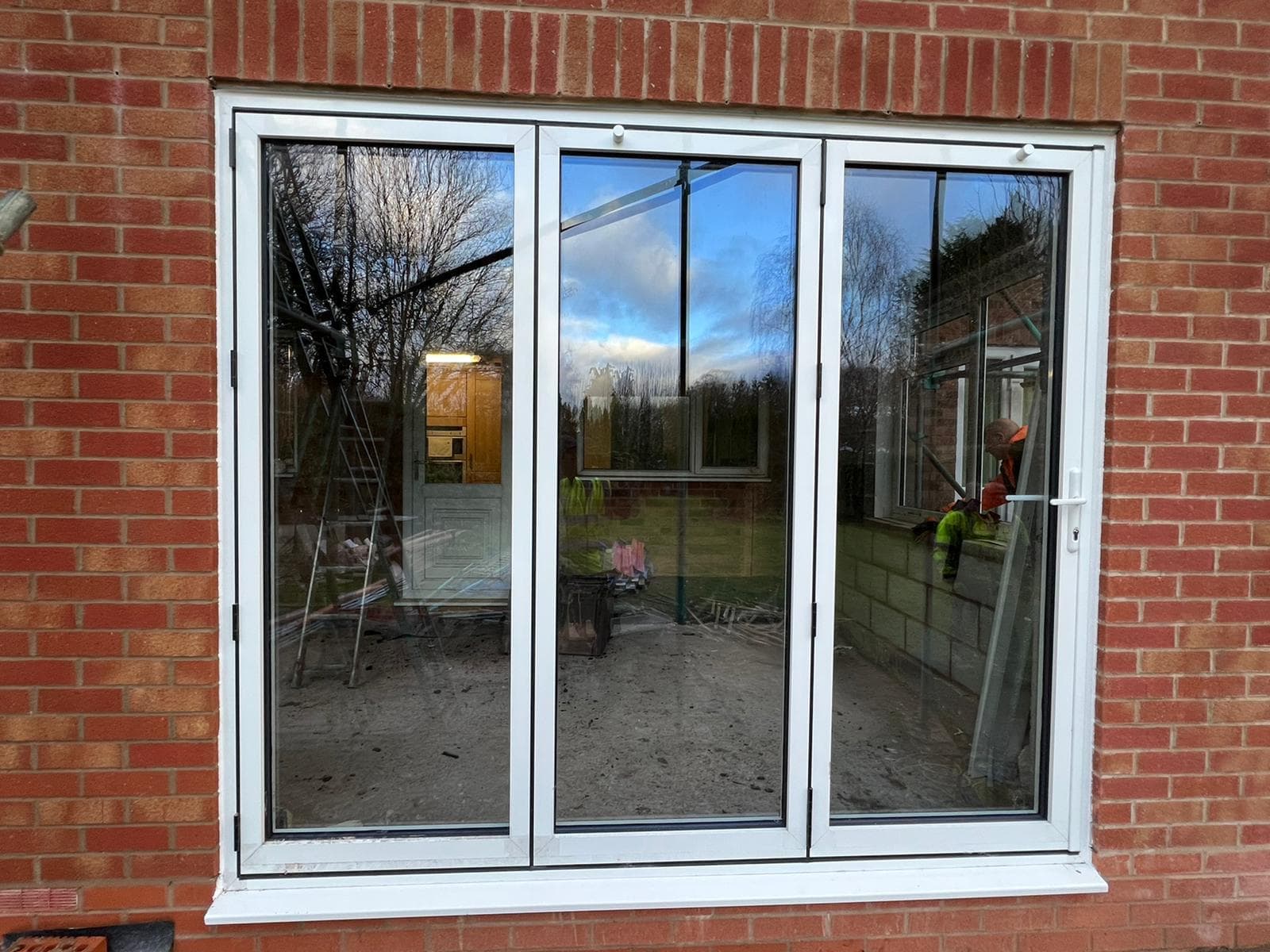
Bi-Fold Doors
Commercial aluminium bi-fold door systems for retail, hospitality, and leisure premises. Open up your frontage completely with thermally broken, weather-rated folding configurations.
Commercial bi-fold door systems — sometimes called bifold or folding-sliding doors — are increasingly specified for retail, hospitality, and leisure premises where the ability to open up an entire frontage or elevation creates a fundamentally different trading proposition. A café that can open its complete street-facing wall on a warm day, or a showroom that can create a seamless transition between indoor display and an external forecourt, gains a competitive advantage that a conventional hinged or sliding arrangement simply cannot replicate.
Sigma Shop Fronts designs and installs commercial aluminium bi-fold systems to suit openings from 2 m to over 12 m in width. Our systems are sourced from fabricators whose products are independently tested and certified to the performance standards that commercial applications demand.
How Commercial Bi-Fold Systems Work
A bi-fold door system consists of a series of individual door panels — typically between two and eight per run — connected by hinges and suspended from a top-hung track or supported by a bottom-running track. When opening, the panels fold against each other accordion-fashion and stack compactly to one or both sides of the opening, creating the maximum possible clear aperture.
Top-hung systems are preferred for commercial use: because the track carries the panel weight, the floor threshold can be a low-profile weather seal rather than a structural bottom track, minimising the trip hazard and improving DDA compliance. Bottom-running systems are used where the header structure cannot carry the suspended load, but they require a more substantial threshold detail.
The stacking configuration — whether panels fold to the left, to the right, or split to both sides — is determined by the operational requirements and the available stacking space. Traffic-door options (a separate hinged panel within the bi-fold run that operates independently) allow pedestrian access without opening the full system.
Weather Performance and Testing
Commercial bi-fold doors are exposed to the full range of UK weather conditions, including driving rain, wind loads, and thermal cycling. The relevant performance standard is BS 6375, which covers air permeability, watertightness, and wind resistance for opening building elements. For commercial premises facing exposed street elevations, we specify systems tested to the mid-range or upper categories of BS 6375 — typically Class 3 or 4 for watertightness and Category B or C for wind resistance — rather than the lower-category systems marketed primarily at the residential sector.
Thermal performance is addressed through thermally broken frame profiles. Unlike most residential bi-fold systems, which use a standard aluminium section, our commercial-grade systems incorporate a continuous polyamide thermal break throughout the frame and sill, delivering a complete door assembly U-value compliant with Building Regulations Part L for non-domestic buildings.
Structural Requirements
Opening up a large section of an existing building elevation for a bi-fold installation almost always involves structural work. The removal of masonry or the widening of an existing opening requires a structural engineer's design for the replacement lintel or beam — typically a steel universal beam or a reinforced concrete boot lintel — sized to carry the loads above, including wind uplift and the weight of the new door system.
We coordinate this structural work as part of our project management service, and where Building Regulations approval is required for the structural alteration, we manage the application through an Approved Inspector or local authority building control.
Glazing and Security
Bi-fold door panels are typically glazed with double-glazed units incorporating toughened outer and inner panes. For enhanced security, laminated inner panes to BS EN ISO 12543 (laminated glass) can be specified; these resist the smash-and-grab attack that a toughened monolithic pane is vulnerable to after initial fracture.
Locking is provided at multiple points along each panel. The outermost panel — the one that closes against the threshold and jamb when the system is shut — carries the primary locking hardware, typically a multi-point espagnolette or shoot-bolt system engaging the frame at the head, sill, and strike side. The folded stack of inner panels is secured against the outer panel by secondary locks.
For overnight security in high-footfall or high-risk locations, bi-fold systems can be combined with a roller shutter in the same structural opening, with the shutter housing concealed within the header detail above the bi-fold frame.
How It Works
From initial enquiry to completed installation — here is what to expect when you choose Sigma Shop Fronts for your bi-fold doors project.
Design Brief
We discuss how you intend to use the opening — fully open retail frontage, café terrace access, or showroom display — and establish the number of panels, opening direction, and traffic door requirements.
Site Survey
Our surveyor measures the structural opening, checks the floor level and threshold detail, and assesses the track fixing points and parking zone where the folded panels will stack.
Configuration & Quote
We finalise the panel count, glazing specification, frame colour, and locking arrangement. A full quotation with technical drawings is provided for approval.
Installation
The top track, threshold, and panels are installed and aligned. Our team adjusts all rollers, hinges, and seals to ensure smooth operation across the full opening span.
Demonstration & Sign-Off
We demonstrate the folding sequence, locking operation, and traffic door function to your team. Warranty documents, care instructions, and guarantee certificates are provided.
What Do Commercial Bi-Fold Doors Cost?
Bi-fold door pricing is determined by the number of panels, total opening width, glazing specification, and whether a traffic door is included. Thermally broken aluminium frames and enhanced security glazing are standard on all our commercial systems.
All prices exclude VAT. Final cost confirmed after site survey.
Bi-Fold Doors — Frequently Asked Questions
Commercial top-hung bi-fold systems can accommodate anywhere from two to ten or more panels in a single run, depending on the track capacity and the available stacking space. Beyond eight panels in a single stack, it is usually preferable to use a split configuration — panels stacking to both ends — to keep stack depth manageable and reduce the operating force. We design the configuration at the survey stage based on the opening width, operational requirements, and available stacking space.
Replacing an existing shopfront with a bi-fold system may be permitted development in many cases, but widening the structural opening or significantly changing the appearance of the building facade requires planning permission, particularly in conservation areas or for listed buildings. Where Building Regulations apply — for a new structural opening or for compliance with Part L energy performance requirements — we manage the relevant submissions on the client's behalf.
A correctly specified commercial bi-fold with multi-point locking on the closing panel and secondary locks on the folded stack provides reasonable security against opportunistic attack. For higher-risk locations, we recommend combining the bi-fold with a roller shutter — either face-fit or within a concealed header box — that provides a solid steel barrier for overnight security. This combination is the standard specification for hospitality premises in busy urban centres.
Bi-fold systems require annual maintenance: lubrication of the top track rollers and hinge pivots, adjustment of panel alignment and seal compression, testing of all locking points, and inspection of the glazing seals. In coastal or high-pollution environments, we recommend six-monthly cleaning and inspection of the aluminium sections and hardware to prevent corrosion of exposed steel components within the locking mechanism.
People Also Ask
Are bi-fold doors secure enough for a commercial shopfront?
Can bi-fold doors be used as a main entrance?
How wide can a commercial bi-fold opening be?
Do bi-fold doors meet Building Regulations for thermal performance?
Bi-Fold Doors Across the UK
We install and service bi-fold doors nationwide. Choose your city for local pricing, coverage areas and recent projects.
- Bi-Fold Doors in London
- Bi-Fold Doors in Birmingham
- Bi-Fold Doors in Manchester
- Bi-Fold Doors in Leeds
- Bi-Fold Doors in Liverpool
- Bi-Fold Doors in Bristol
- Bi-Fold Doors in Sheffield
- Bi-Fold Doors in Glasgow
- Bi-Fold Doors in Cardiff
- Bi-Fold Doors in Newcastle
- Bi-Fold Doors in Nottingham
- Bi-Fold Doors in Leicester
- Bi-Fold Doors in Edinburgh
- Bi-Fold Doors in Southampton
- Bi-Fold Doors in Brighton
- Bi-Fold Doors in Coventry
- Bi-Fold Doors in Reading
- Bi-Fold Doors in Wolverhampton
- Bi-Fold Doors in Derby
- Bi-Fold Doors in Northampton
- Bi-Fold Doors in Luton
- Bi-Fold Doors in Swindon
- Bi-Fold Doors in Stoke-on-Trent
- Bi-Fold Doors in Plymouth
- Bi-Fold Doors in Bradford
- Bi-Fold Doors in Swansea
- Bi-Fold Doors in Oxford
- Bi-Fold Doors in Cambridge
- Bi-Fold Doors in York
- Bi-Fold Doors in Bath
- Bi-Fold Doors in Aberdeen
- Bi-Fold Doors in Belfast
- Bi-Fold Doors in Milton Keynes
- Bi-Fold Doors in Middlesbrough
- Bi-Fold Doors in Bournemouth
- Bi-Fold Doors in Portsmouth
- Bi-Fold Doors in Norwich
- Bi-Fold Doors in Exeter
- Bi-Fold Doors in Chester
- Bi-Fold Doors in Gloucester
- Bi-Fold Doors in Peterborough
Ready to Get Started?
Tell us about your bi-fold doors project and we will arrange a free site survey at a time that suits you.
- Free no-obligation survey
- Written quotation within 48 hours
- Nationwide installation teams
